Don’t Use Butter! How to Safely Treat Burns.

Sunday afternoon— A curious toddler waddles into the kitchen, attracted by the smell of fresh homemade cooking. His wandering eyes fixate on the oven and the luring pot of bubbling liquid perched precariously on the edge of the stove-top. He makes a beeline for the pot handle sticking over the edge… just within his grasp… he leaps up and pulls the entire pot of boiling hot soup onto himself. His parents hear the sudden screams  and bolt to the kitchen to find their toddler badly burnedWhat would you do to treat a burn?

Burns are very common. According to the American Burn Association, over 486,000 people received medical treatment for burns last year, and 40,000 victims were hospitalized.

Burns can be caused by contact with extreme heat, chemicals, radiation or electricity.

How do I know if a burn is severe?

Burns range from minor to severe. Severe burns, include:

Burns to children younger than 5 years old.

Burns to adults older than 60 years old.

Burns to the head, face, throat, hands, feet or genitalia.

Burns that cause difficulty breathing.

Burns from electricity; explosions; chemicals or radiation.

Burns covering a large part of the body.

In order from least to most severe:

First Degree (superficial):

Affects just the outer layer of the skin.

Skin may appear red or painful.

Usually not life-threatening, unless it covers a very large area of the body.

Examples include sunburns and minor burns from a stove.

Second Degree (partial thickness) 

Penetrates deeper into the skin.

Skin will show blisters.

Can be serious or life-threatening if spread over a large area or affecting sensitive areas like the face, hands, feet, or genitalia.

Third Degree (full thickness)

Penetrates through multiple layers of skin to the muscle and bone beneath.

Skin may appear waxy, yellow or black.

Life-threatening.

If you suspect someone has a severe burn, Call 9-1-1 immediately.

How can I treat a Burn?

STOP —> COOL —> COVER

STOP the Burning Process.

If the person is on fire, tell them to stop, drop and roll until the fire is out.

Remove them from the source of the heat – douse the patient with water, if needed.

If clothing is not stuck to the skin, carefully remove the clothing from the burned area.

For chemical-powder burns – brush off any dry powders using a gloved-hand before rinsing with water.

For chemical liquids – flush the area with cool, running water for 15 minutes.

For electrical burns – turn off the electricity at its source before touching the patient.

Cool the Burned Area.

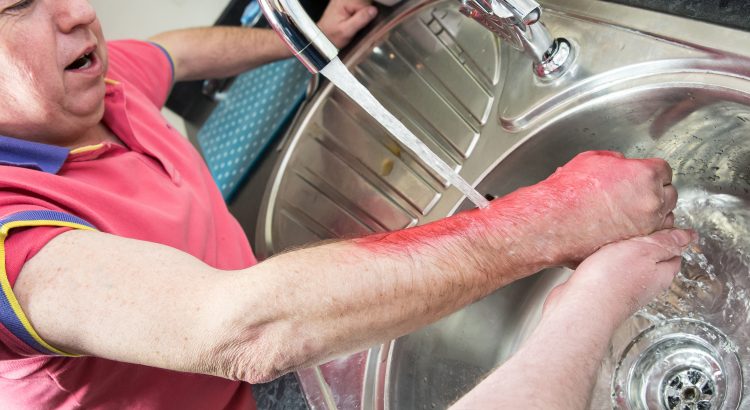
Irrigate the area as soon as possible with clean, cool water for at least 10 minutes or until the pain goes away whichever is longer.

Do NOT use ice. (It can damage a burned area).

Do NOT use butter or other ointments. (Greasy substances can trap in heat and cause worse damage).

Cover the Injury.

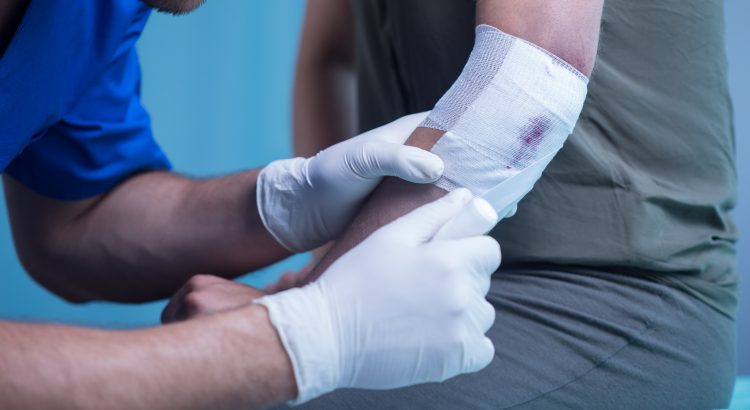
Using a clean and sterile dressing, cover the burned area to prevent infection and avoid the loss of body heat.

For severe burns or burns covering a large area of the body –> Treat for shock by covering the person with a blanket to keep them warm and call 911.

Summary: In the case of the toddler burned by soup, what would you do?

  1. Call or send someone else to call 9-1-1.
  2. Rinse the child with cool running water over the burned area for at least 10 minutes and remove clothing not stuck to the skin.
  3. After cooling the burns, cover the burned area with clean dressings.
  4. Given the large size of the burn, cover the patient with a blanket to keep them warm and treat for shock.
  5. Monitor the patient to see if they need CPR (9-1-1 operators can help you with this).

Empower yourself with real knowledge on how to treat a burn and respond to many other emergencies, register for a CPR First Aid certification course Today!

Someone’s seizing on the train! What should you do?

You’re riding the A-train express between 59th and 125th street. As the train picks up speed, you hear a commotion at the end of the car – an elderly man has suddenly starting seizing violently. His arms and legs tense and jerking, eyes rolled up so all you can see is white, bloody foam pouring from his mouth.

What should you do?

The answer is:  not much.

Seizures occur when a person experiences abnormal electrical activity in the brain. Many things can cause a seizure, including low blood sugar, brain tumors, epilepsy, head trauma and others. During a seizure, a person may lose consciousness and experience muscular jerking of the arms, legs, head and neck. A person might also bite their tongue during a seizure, resulting in bleeding from the mouth.

What can I do to help someone who’s having a seizure?

As scary as seizures may look, they’re usually not that dangerous. Calling for help and taking a few simple steps can help the patient avoid injury. Here are some things you should do:

Call 9-1-1 immediately. Although most seizures will end on their own, sometimes additional medication is required to stop a seizure. Paramedics have this lifesaving medication. Call 9-1-1 for anyone who appears to be unconscious or seizing.

Protect the head and body. Try to protect the head from injury by placing something soft (like a pillow or towel) under the person’s head until the seizure is over. When the seizure ends, it might be better to remove the soft item to allow fluids to properly drain out of the mouth. Move furniture and other items out of the way to prevent injury. It might be necessary to move the patient into a safe position. For example, if someone is seizing by the edge of a subway platform, you should try to drag the person to safety.

Do not attempt to prevent the patient from shaking. Holding the person back or trying to stop him from shaking can cause further injury.

Do not stick anything into the patient’s mouth. Although a patient may bite their tongue during a seizure, it’s not a big deal (usually a small cut), and putting sticks, fingers or spoons into a seizing patient’s mouth can cause damage. If you can do so safely, roll the patient onto his side to try to let the fluids drain out instead of pooling in the back of the mouth.

What do I do after a seizure is over?

The patient will usually remain unresponsive for the first few minutes and then slowly wake up. This is normal. 

You should immediately do 2 things:

Look to see if the patient is breathing (if not, begin CPR).

If no CPR is required, roll the patient onto his side to prevent him from choking on blood, spit and other fluids in the mouth.

When in doubt, call 911.

Empower yourself with real knowledge on how to help someone having a seizure and many other emergencies – Take a First Aid CPR certification class Today!

Stroke Symptoms

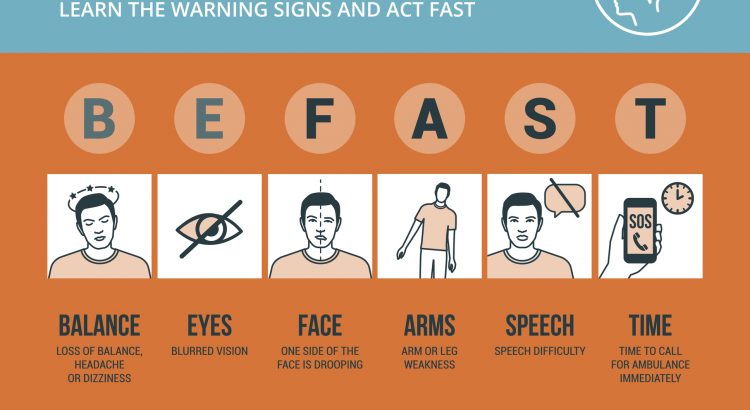
Think FAST! Is your loved one having a stroke?

Stroke can occur very suddenly and without warning when a blood vessel in the brain becomes blocked or bursts.

It can affect people of all ages (not just the elderly!)

A stroke can cause permanent brain damage or even death, but when recognized and treated quickly, sometimes the damage can be stopped or reversed.

What are the Signs and Symptoms of Stroke?

Each patient may experience a stroke differently, but common signs include:

Difficulty speaking, slurred speech, being unable to form words, or being unable to understand what others are saying

Drooling or difficulty swallowing

Drooping on one side of the face

Trouble seeing in one or both eyes

Weakness, numbness or paralysis – especially on one side of the body

Sudden, severe headache

Dizziness or Loss of Balance

Confusion

Unresponsiveness

Any single one of these symptoms could be a stroke — a real stroke victim might not have all of them.

Learn the FAST Check

5713fast

The American Heart Association encourages people to know the FAST check:

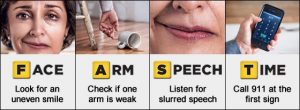
F = Face — Ask the patient to smile widely. Does he have drooping on one side of the face?

A = Arm — Ask the patient to raise both arms. Does one arm drift downward?

S = Speech — Ask the patient to say “The Sky is Blue.” Is the speech slurred, nonsensical or absent?

T = Time to Call 911 — if you answered “YES” to any of the questions above, immediately call 911 to report a possible stroke.

Always err on the side of caution. If you’re not sure, CALL 911.

“Time is Brain” — the longer you wait, the more permanent brain damage may be caused.

Empower yourself with real knowledge on how to respond to a stroke and many other emergencies – Take a First Aid CPR Class Today!

CPR hand placement

How can I tell if someone needs CPR?

Your friend collapses at the gym and becomes unconscious!

A bunch of people run over, but no one seems to know how to help… Should you begin CPR?

These situations can often be scary. To help you remember what to do, it’s best to keep things simple:

No Response + No Regular Breathing = NEEDS CPR

That’s it. If you remember that simple equation, you can remember how to act when someone collapses. Let’s break this down a bit more:

“Response” means a patient moves, blinks, speaks, or otherwise reacts when you tap on his shoulders and ask if their okay.

“Breathing” means a patient’s chest moves up and down smoothly, quietly, and rhythmically.

Warning!   “Gasping” is not breathing. If you find someone who is unresponsive, and irregularly gasping – they need CPR.

How do I perform CPR?

If you see someone collapse…

Check Response: Tap-and-Shout on their shoulders to see if they respond. If no response…

Check Breathing:  Look at the chest for 10 seconds to see if it rises and falls normally. If no breathing or only gasping…

Call: or send someone else to call 911 and get an AED (defibrillator)

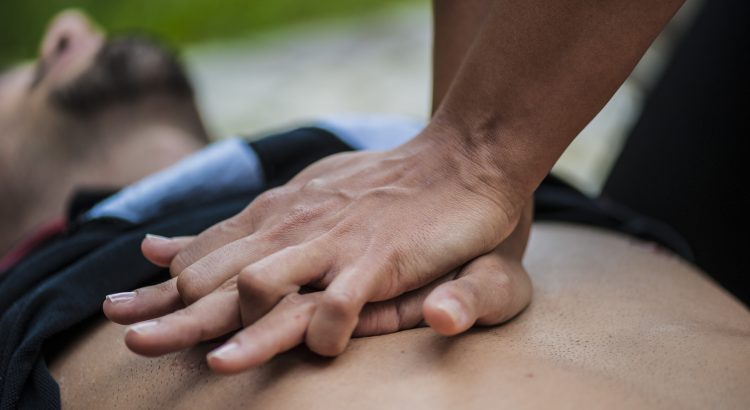
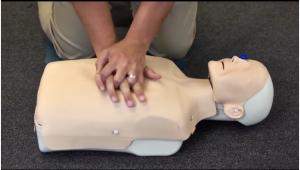
Care: Begin hands only CPR by putting the heel of one hand in the center of the chest between the nipples. Place your second hand on top of the first and lock your fingers together. Push hard and fast in the center of the chest until the patient wakes up or a CPR certified individual arrives and takes over. If an AED (defibrillator) arrives, turn it on and follow the voice and visual prompts – the machine will tell you exactly what to do!

Hands-only CPR
Hand placement for CPR

Empower yourself with real knowledge on how to respond to an emergency Take a CPR certification class Today!

First Aid for bleeding

Ouch! You’re bleeding! What should you do?

Scenario:

You’re in the kitchen chopping vegetables for dinner. As you begin picking up speed, you suddenly feel a searing pain on your hand and notice a red spray of blood pouring onto the counter. You look at your hand and realize you’ve cut yourself deeply. It looks really bad.

What should you do?

Bleeding from an open wound is a common injury that most people experience at least once during their lifetime. Bleeding can range from minor to severe. It can be divided into three types:

Capillary bleeds = Usually a minor wound that doesn’t breech a large blood vessel. This type of wound slowly “oozes” blood. This wound pattern can include scrapes (abrasions) and small cuts.

Veinous bleeds = A wound breeches a vein and heavy bleeding can occur. In some cases this can be life-threatening.

Arterial bleeds = A high-pressure artery is cut, sending blood spurting out of the wound under significant pressure each time the heart beats. This is a life-threatening injury.

How do I help someone who is bleeding?

For major bleeding, send someone to call 9-1-1

Take gauze from a first aid kit and apply hard, consistent pressure directly on top of the wound.

If you don’t have gauze, use any clean piece of cloth instead.

If blood soaks through the first piece of gauze, do not remove it. Taking off old gauze might tear out clots and cause bleeding to worsen. Instead, place additional pieces of gauze on top of the original.

Maintain firm pressure on top of the wound, until bleeding slows down. This may take several minutes.

Once bleeding stops or slows down, use a roller bandage to secure the gauze in place.

If the bleeding does not stop -> continue to maintain firm pressure on the wound, and consider the use of a tourniquet, if you are trained to use one.

After taking steps to stop bleeding, check your victim for signs of “shock” – a life-threatening condition that can be caused by significant blood loss.

What are the signs of shock?

Pale, ashen, cool, moist skin

Excessive thirst

Rapid breathing and/or pulse

Dizziness / weakness

Nausea / vomiting

Anxiety / disorientation

How do I help if someone has lost a lot of blood?

Call 911.

Help the patient lay down flat on the ground

Cover them with a blanket

Ensure external bleeding remains controlled.

To learn more about life threatening bleeding and shock, sign up for a First Aid CPR AED class today!