CPR hand placement

How can I tell if someone needs CPR?

Your friend collapses at the gym and becomes unconscious!

A bunch of people run over, but no one seems to know how to help… Should you begin CPR?

These situations can often be scary. To help you remember what to do, it’s best to keep things simple:

No Response + No Regular Breathing = NEEDS CPR

That’s it. If you remember that simple equation, you can remember how to act when someone collapses. Let’s break this down a bit more:

“Response” means a patient moves, blinks, speaks, or otherwise reacts when you tap on his shoulders and ask if their okay.

“Breathing” means a patient’s chest moves up and down smoothly, quietly, and rhythmically.

Warning!   “Gasping” is not breathing. If you find someone who is unresponsive, and irregularly gasping – they need CPR.

How do I perform CPR?

If you see someone collapse…

Check Response: Tap-and-Shout on their shoulders to see if they respond. If no response…

Check Breathing:  Look at the chest for 10 seconds to see if it rises and falls normally. If no breathing or only gasping…

Call: or send someone else to call 911 and get an AED (defibrillator)

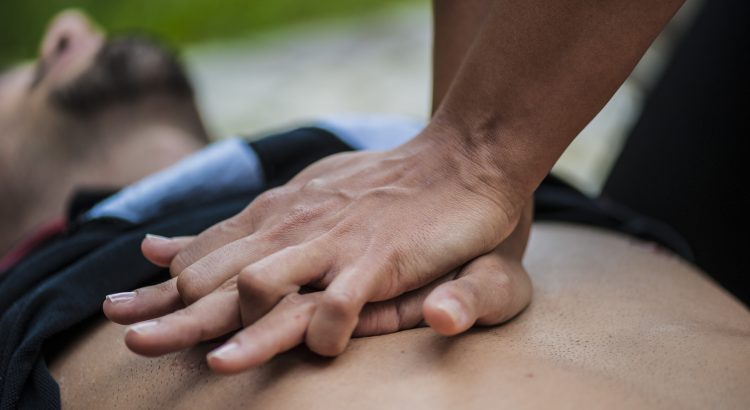
Care: Begin hands only CPR by putting the heel of one hand in the center of the chest between the nipples. Place your second hand on top of the first and lock your fingers together. Push hard and fast in the center of the chest until the patient wakes up or a CPR certified individual arrives and takes over. If an AED (defibrillator) arrives, turn it on and follow the voice and visual prompts – the machine will tell you exactly what to do!
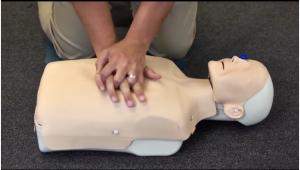
Hands-only CPR
Hand placement for CPR

Empower yourself with real knowledge on how to respond to an emergency Take a CPR certification class Today!
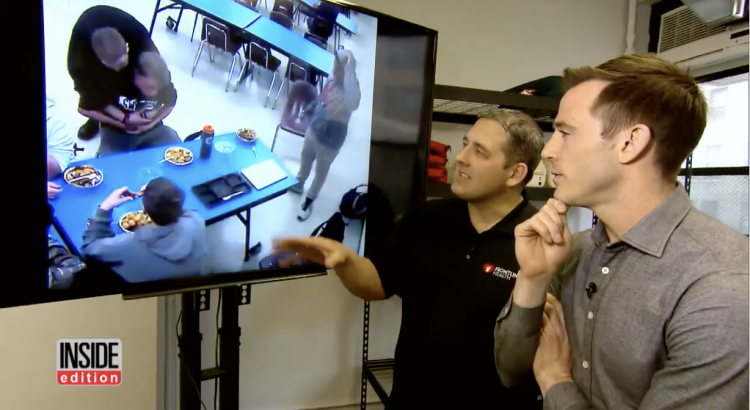
Shane Woodall, of Frontline Health CPR Training in NY on Inside Edition

Frontline Health Featured on National TV – Again!

As a training center with over two decades of experience training thousands of students in CPR and First Aid, Frontline Health is often asked by local and national news outlets to discuss life-saving techniques.

This past Friday, Shane Woodall, President of Frontline Health and himself an experienced instructor, appeared on Inside Edition to discuss the Heimlich maneuver and comment on a recent incident in which a Wisconsin student was saved from choking on a cheeseball.

Find out for yourself why Frontline Health has thousands of satisfied customers:

  • Expert American Heart Association and American Red Cross instructors with decades of real life medical experience as EMTs, Paramedics and Nurses.
  • Convenient midtown training facility featuring state-of-the-art equipment
  • Same-Day Certification
  • On-site courses available – we’ll come to you.

Empower yourself with real knowledge on how to respond to an emergency – Enroll in a First Aid CPR AED class.

Heart Attack

Heart Attacks: How to Save a Life

According to the American Heart Association, each year about 635,000 people experience a new heart attack in the United States. An astounding 1 out of 7 deaths in the U.S. is caused by coronary heart disease (AHA). Learning how to recognize and treat a heart attack can save the life of a friend or loved one.

What is a heart attack?

The heart needs a continuous supply of blood and oxygen to survive. During a heart attack, a partial or complete blockage occurs in one or more of the heart’s pipes, or “arteries.” This blockage causes a section of the heart to become damaged from a lack of nutrients.

This can produce pain and other symptoms. If the blockage is not fixed, permanent damage and death can result. Although a heart attack victim is usually awake at first, severe heart attacks can cause someone to lose consciousness and stop breathing – a condition called cardiac arrest which requires CPR.

What are the signs of a heart attack?

Chest discomfort, which can include: pain, pressure, squeezing, tightness, fullness, burning etc.

Pain or other sensations in other areas of the body including:

One or both arms

Neck

Jaw

Back (between the shoulder blades)

Abdomen

Difficulty breathing or shortness of breath

Nausea / vomiting

Dizziness / weakness / fainting

Pale, cool, moist skin

Rapid heartbeat

Slow heartbeat

Certain types of patients – including women, diabetics and the elderly – often experience symptoms other than chest pain during a heart attack.

How can I treat a heart attack?

If you think someone might be having a heart attack, do the following:

Call or send someone to call 9-1-1

If an AED is available at your workplace, send someone to get it.

Keep the patient as calm as possible.

If the patient is above 18 years of age and has no allergies to it, administer two (2) chewable 81mg tablets of low dose aspirin or one (1) chewable tablet of regular adult dose aspirin. Aspirin has been shown to save lives during heart attacks by reducing clotting in the bloodstream.

Monitor the patient’s consciousness and breathing.

If the patient becomes unconscious, immediately move them to the ground and check to see if CPR is needed:

If the patient is unresponsive and not breathing (or only gasping) -> Immediately Begin CPR

If the patient is breathing, roll them onto their side to protect the airway and remain vigilant to see if breathing stops until the ambulance takes over.

You can learn more about how to help a person experiencing a Heart Attack by taking a First Aid CPR AED course.

Scales of Justice

Do I need to ask for permission to give CPR or First Aid?

When you take a CPR or First Aid class, you typically are taught about the rules of consent.  This is a formal term which means “asking for permission.” The basic premise is that people have a right to decide what happens to their bodies (the fancy term for this is “personal autonomy.”) Therefore, it’s considered unethical (and potentially illegal) to provide care to someone without permission.

How do I ask for consent to provide care?

  • If someone is above the age of 18 and is awake, simply ask them if you can help. Tell them who you are, what level of training you have, explain what you plan to do and ask if you can help.
  • If the victim is under the age of 18, ask a parent or guardian for permission on the child’s behalf.

What if someone is unconscious – do I need to ask for consent?

  • No. When a patient above the age of 18 is unresponsive, you can help the patient even without explicit consent. This is called implied consent – meaning, we assume that, had the patient been awake, he would’ve wanted our help.

What if the child has no guardian present – who do I ask for consent?

  • If there is no parent or guardian present, and you are faced with a minor who is suffering a life-threatening emergency, you are permitted to help that minor without obtaining consent – this is called implied consent – meaning, we assume that, had the parents been present, they would’ve granted us permission to help their child.

To learn more about consent and how to help in an emergency enroll in a First Aid CPR AED course.

How to help a choking victim

You and a friend are eating lunch together. All of sudden you see your friend grab her throat – a panicked look spreads across her face as she starts to turn purple. You quickly realize your friend is choking.

17107

What is choking?

Choking is caused when food or some other object blocks a person’s airway and prevents them from breathing. Choking can occur very suddenly in patients of any age. If not rapidly treated, choking quickly leads to death.

Signs of choking

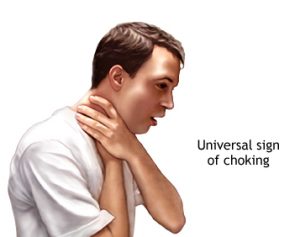
  • Universal choking sign (grabbing or pointing at the throat)
  • Inability to speak
  • Inability to cough
  • Face changing color
  • A panicked look

How can I help someone who is Choking?

  • Send someone to call 9-1-1
  • Take steps to get the object out:
  1. Stand behind the person and bend them down at the waist so they are staring at the ground.
  2. Using the heel of your hand, hit them hard on the back between the shoulder blades 5 times.
  3. Then, have them stand straight up and position yourself behind them.1098-2
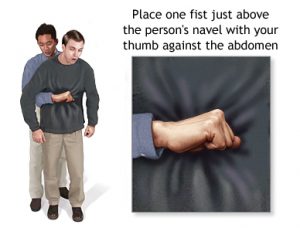
  4. Wrap your arms around the person’s abdomen. Make a fist with one hand and place it in the center of the abdomen just above the belly button and beneath the breast bone. Grab your fist with your other hand and give forceful inward & upward thrusts into the abdomen 5 times
  • Repeat as needed until the object comes out, and the person can speak, breathe or cough or until they become unresponsive.
  • If they become unresponsive, call 911 and begin CPR.

Note: If a patient is able to cough forcefully and move air, don’t touch them! Encourage them to cough and call 9-1-1 if needed.

For more details on Choking relief and other First Aid emergencies, Enroll in a First Aid CPR AED training class.